Thursday, January 27, 2011


Let's take a minute here at the beginning of this post to understand the difference between drawing and printmaking. Drawing is a direct process, one art work is produced. While an artist might make two drawings very similar, each work would be an individual art work made by hand. Printmaking is sometimes referred to as plate making. Here the art is created by first building a plate from some material such as wood , stone, plastic or metal. The plate is inked to produce the art work, which may be any number and each work is exactly the same.

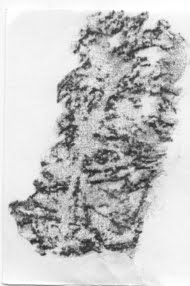
The indigenous American artist probably did design these stones to be used as printing plates, however they mixed printing and drawing techniques in practice to produce beautiful effects. It is very likely that more than one art work might have been produced with a single plate. Through a process called “selective inking” only a portion of a particular plate was used to create an art work. When we observe the prints that appear here, we must take into account that the entire plate is visible, printed in one rub, these are documentary proofs of the entire plate structure.

You can reach me at ciaamuseum@gmail.com

Thursday, January 20, 2011


I do hope that you are enjoying the post on my blog from week to week. Like I have said in previous post, it is not as important what I write as it is obviously the rare illustrations that make this blog unique..I would like to add a word of further explanation here. When I read that Google had created Blogger I immediately thought that this would be an excellent way to offer everyone an access to the images in the collection . Please let me say that I am very satisfied with the program, and that I will continue to post. I haven't forgotten that I did say that I would also show photographs of some of the effigy stones, this is taking longer than I anticipated, but eventually there will be those illustrations as well.

Not all of us see the same reality, sometimes what we see is the product of our individual development or possibility our personal preparation. Education does prepare us for understanding and appreciating the Arts. When an individual works and acquires advanced degrees, we should all seek to honor and serve that person by accounting and posting our personal studies when we honestly feel that a truth of worth has been found. I do feel that this is the case here, that The Collection Of Indigenous American Art is an unusual collection of works, and that placing some of these works on public view is in order.

You can contact me at ciaamuseum@gmail.com

Thursday, January 13, 2011


When I began the actual printing of the stones in my collection I was quickly aware that there would be many people that by all means would see the art work as a collectable domain, that to many it might represent an alternative to the” Known Artist” collections that fill gallerys and museums all over the world today. It is actually rare for “ Unknown” works to appear in large numbers in the art market. The art of unknown artist are commonly barred from most exhibitions, so there is little opportunity for the public to see such work.

Have you ever tried to select an art work for view in a public place? I mean in a place or location where a number of individuals have to agree on a particular piece! Often indeed the attempt fails entirely and the wall remains bare, “indeed”! Political ties, Religious beliefs, Nationality or the personal habits of the artist are the types of foolish predigest that will frequently halt the process, ill feelings often linger for months.

I see the art of unknown artist as a natural choice, especially when the art work itself is quite good and interesting to view. What is better than seeing a unique graphic that is entirely new to you and all other viewers as well.

Contact me at ciaamuseum@gmail.com

Thursday, January 6, 2011


Well now we have the new year started, do hope that yours was a nice holiday. I would like to explain about the prints that they are enlarged somewhat by the process of importing them into the Blogger program. I am still learning about the tools that I am attempting to use. The basic idea here is that I create an artist proof using a Crayola Crayon. Most of the plates are printed only twice. The first rubbing is made on common notebook filler paper and the second is on equally common word processor paper. Then the second proof is scanned into my Epson NX400 printer which exports the image to my HP pavilion desktop, where the images are stored in the pictures file. I then use Picasa software to order the prints that are then uploaded to Picasa Web Albums on-line. You can see all of the prints that have been published here on the blog and some that I have omitted as well.

Once again please let me point out that recognizing the image is in many cases a difficult study I try to place only prints that I am certain of, but that does not guarantee that they will all be intelligible to all viewers. I do by all means recommend that the viewer move back from the monitor to study each print. Also, rotating the image 360 degrees in 90 degree clicks shows other faces of of what are multiple viewpoint compositions. Many times you may like a particular work in another position. We must remember that the artist that created these art works did not think of their works as having a top or bottom.

You can reach me at ciaamuseum@gmail.com

Thursday, December 30, 2010


In my last post I tried to encourage the reader to consider computer equipment a necessity of life. Good equipment is a great economy. If you think about it, how incredible it is that a person can buy so much for so little! Practically every aspect of human life is effected by the development of computer literacy. Once a person learns operation skills the overall benefit is obviously worth far more than the equipment cost.

Last month I was researching topics that I might use in my blog post, naturally I entered a query statement “Indigenous American Art” to see what Wikipedia might yield on the subject, as I read the posted sources on the Google Search Engine page , I spied a familiar title , “The Collection of Indigenous American Art”, I was defensive, literally fearful that I might have someone Elise's title! But, then I realized that it was my title to these pages. Now the point is this, the important content here is the rare art work of the Indigenous American Craftsmen. Google and affordable personal computer equipment have made this view possible.

Several new prints follow!

You can reach me at ciaamuseum@gmail.com

Thursday, December 23, 2010


Let me start this post by wishing you a Merry Christmas and a Happy New Year as well. I will forgo the normal writing and suggest that computer equipment is the best Gift that you can give! Rather it is for yourself or another person, so many meaningful accomplishments start with a knowledge of computer hardware and software. Money spent on computers is invested in the future of the recipient, it is the encouragement to explore and achieve. Once again, Happy Holidays!

Here are several new prints. The prints in last weeks post did not do well, they will be deleted to make room for better work.

You can reach me at lmccarty.fa@gmail.com
.

Friday, December 17, 2010


Now that there are a number of the prints visible, (You can see past post in the archive), It is obvious there is considerable variation from one plate to another. Some are literal while others are more abstract. I think that it is easy to see that modern art work in Europe and the Americas was in large part a reaction to various primitive art forms.

As early as Albrecht Durer's life time, 1471-1528, European artist were viewing exhibitions of art from “ The New World”. Durer wrote in his artist diary that he viewed a group of works in Brussels Belgium. He wrote that they were a pleasure to behold. Do you think that Rembrandt Van Rijn , 1606-1669 , might have been influenced likewise? While Rembrandt is known as a painter, he like Durer was also a print maker, working in the Intaglio process. The American Indians were using the Intaglio process 3500 years ago. The point here is that European artist had been studding Indigenous American artifacts for nearly 400 years by the time that the Armory Show was held in New York City in 1913! Many authority's consider the Armory Show to be the beginning of the Modern period in America.

You may reach me at lmccarty.fa@gmail.com